
Embody the Utility: Why Germany Is Predestined to Create Industrial Intelligence
Intelligence is being manufactured now. Not as software alone, but as an industrial product made from energy, silicon, and compute. When the cost of a thought falls close to zero, intelligence stops being a tool you buy and starts being a utility you build on – like electricity.
That is the shift Nina Schick calls Industrial Intelligence (this is an AI-specific, or AI-native interpretation. In general, this term refers to the ability of digital technologies to integrate with industry). The countries and companies that control the stack (energy, factories that make the intelligence, and the places that actually use it) will shape the next decades. Germany sits in an awkward but interesting spot in that story.
The problem is not a lack of engineers
Germany still has the engineering base, the process knowledge, and the installed machines that the rest of the world wants. What it lacks right now is cheap, abundant power at the scale the new intelligence factories require. After the nuclear shutdown, that gap is real.
The risk is that German industry becomes a sophisticated consumer of intelligence made elsewhere instead of a place that embodies it.
Most companies are currently taking the safer-looking path: give people AI tools, watch individual productivity rise, and hope the company gets better. In practice, the time saved often disappears into checking the AI’s work, coordinating around the old process, and endless meetings.
The structure stays the same. That is the AI-enhanced trap, and it does not move the needle on the real numbers.
The more useful path is narrower
The alternative is to treat intelligence as infrastructure inside the company itself. You do not try to change the whole core at once. You pick one or two high-volume workflows that already matter (for example, turning a complete inquiry into a priced offer, or turning a machine serial number and a parts request into a confirmed list), and you rebuild them as an intelligence stack.
Agents handle the sensing, gathering, drafting, and routing. Humans stay above the loop: they set the constraints, say yes or no on the parts that still need judgment, and own the residual risk. You run the new path in parallel with the old one on the same live work, inside the firewall, reporting to the CEO.
After a few weeks, the numbers are clear. Either the new path is better on cycle time, errors, and cost, or it is not. If it is, you retire the old way for the routine cases and move to the next workflow.
This is slower to start than a chatbot pilot but much faster at showing real results: “Move slow to be fast!”
It also sets up the next step: when those same agents begin to act on physical things (parts, batteries, assemblies), you need a reliable link between the digital decision and the actual object.
A copyable barcode is not enough. The system has to be able to prove it is talking about this specific part, not a lookalike. Humans still own the stop button.
What this actually changes
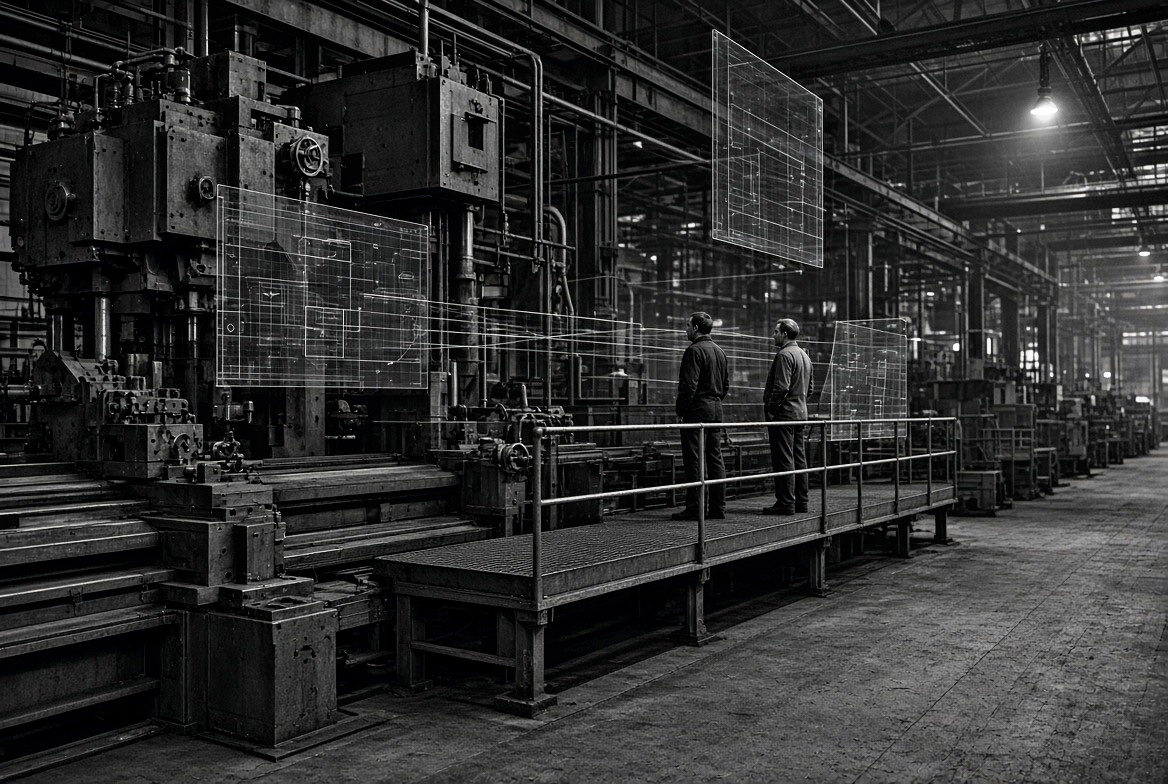
German makers do not need to win the race to build the largest intelligence factories. They can win the race to put abundant intelligence into the physical systems they already understand better than almost anyone.
That means shorter design and quotation cycles, fewer errors that only show up on the shop floor, and plants that can be retasked without freezing the line for months. It also means the learning stays inside the company instead of leaking into a vendor’s black box.
The alternative is more cost-cutting on processes that were built when intelligence was scarce and expensive. Those processes will not survive contact with intelligence that is cheap and everywhere.
Start with the one line of work that two people and an agent stack could rebuild in a couple of months. Name the two workflows. Run them in parallel. Keep humans on the gates that still require judgment. The rest follows from the numbers.
If you’re a top executive who hasn’t yet been able to implement your ideas within your company, and you also couldn’t prevail over the naysayers and skeptics within the company, please contact us. Work with our evolutX team to bring your AI innovation idea to life!