
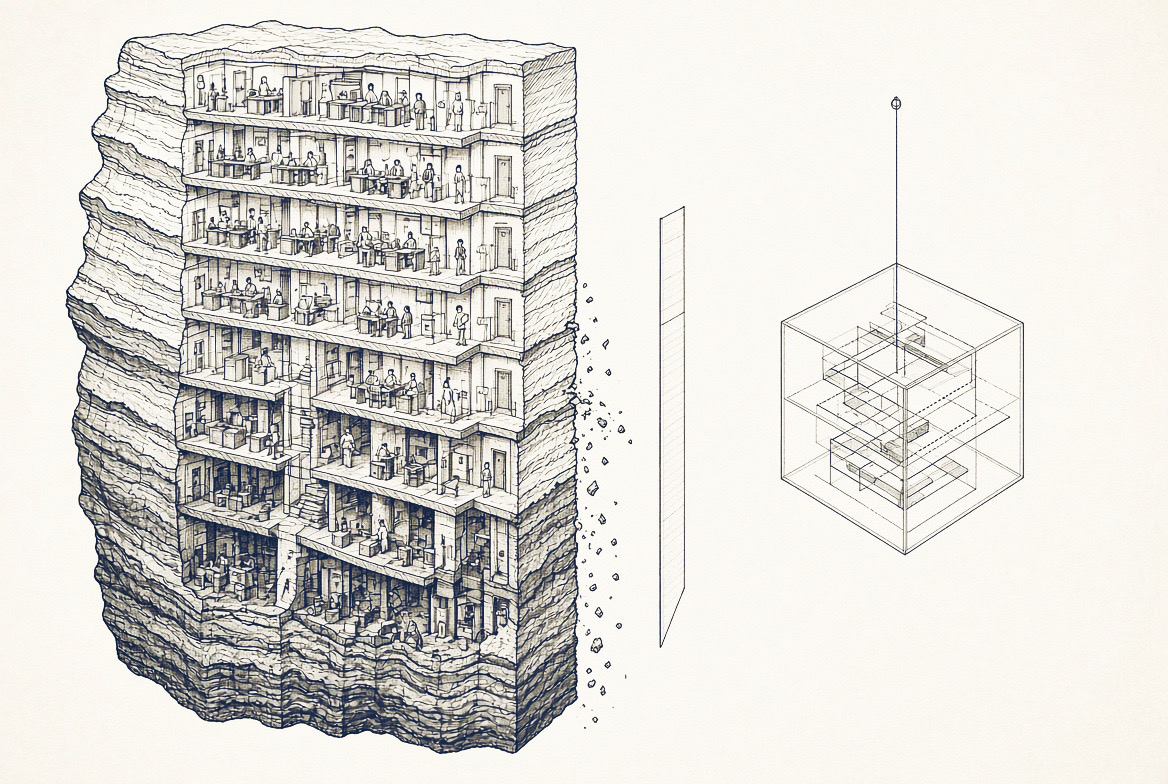
The more of the core you invite into the twin, the more clay you pour into the cut. Adidas and the Evolut Strategy are the same argument in two dialects.
Frank Zappa put the constraint in one sentence:
Without deviation from the norm, progress is not possible.
A large firm is a machine for producing the norm. That is not a moral failure. It is the job the core was hired to do — efficiency, repeatability, predictability, the quarterly close. The sediment that job leaves behind is the corporate clay layer: the people and forums whose default contribution is a no that looks like governance.
Cut through that clay, or do not start. Involving more of the core does not make the new thing safer. It makes the new thing late.
What Gulden said out loud
Adidas CEO Bjørn Gulden named the mechanism that had been sitting on the brand. When he arrived in January 2023, the firm was carrying $1.2 billion of stranded Yeezy inventory, a collapsed China business, and smaller specialists eating share at the edge of the category. Less than four years later, the board extended him through 2030 on the back of growing sales and recovered profit. He did not credit a transformation office.
When a company’s in trouble — a big company with a lot of resources — you need to get the nay-sayers out of the way. Too many layers of people said no to everything.
If you have seven, eight, nine layers in a decision process, you only need one person to say no, and then it stops.
That is the clay, described without metaphor. Seven to nine layers is not an org chart. It is a veto machine. Each layer can be right on its local metric and still kill the only move that would have mattered. One no is enough. The system is designed that way.
The Samba episode is the same fact in product form. In the first week of the job, Gulden was told the classics could not be scaled on the timeline the market was already demanding. Five days later, production was being pulled forward.
The people who had said no were not convened into a working group to socialize the risk. They were taken out of the path. Later he pushed decision rights back toward local markets — 90 to 95 percent of what Adidas sold in China designed, made, and marketed from China — because a headquarters layer that must bless every local SKU is just another no with a better title.
This is not a culture speech. It is an architecture speech. Fewer layers between a live signal and a named person who can say yes.
The Evolut thesis is the same cut
You cannot transform a legacy company from the inside. The Evolut Strategy exists because the core cannot be argued into becoming the edge. Build a governed digital twin at the perimeter — still inside the firewall, reporting to the chief executive. Rebuild two high-throughput workflows on the intelligence stack. Run them in parallel with the core. Deprecate what loses. Take the next workflow. Over nine to twenty months, the edge is no longer the edge. It has evolut_ed into the core.
None of that survives first contact with a committee.
If you ask the immune system for permission to exist, it will give you a steering committee. A steering committee is how twins die. The committee is the clay, reconstituted as a calendar. Decisions that should take a day wait for the next slot. The parallel run never accumulates enough instances to argue with.
The lighthouse swap arrives: a chatbot the board can screenshot instead of two named chains on live files. Then the budget reverts to the innovation envelope, and “sharing learnings with the core” absorbs the edge without ever beating the incumbent on evidence.
The pattern does not require villains. CFO, CIO, process owners, works council, legal — they are doing the job the firm trained them to do. Most change programs do destroy margin and leave a deck. Their no is rational.
That is why you do not put them on a working group and ask them to bless the twin’s existence. You write a mandate that answers their questions before they ask them, invites them into specific jobs, and locks them out of others.
Finance instruments the parallel run. Legal and information security design the evaluation band and the week-one rollback. The process owner is the named gate on the two workflows — which means they can refuse a draft. They cannot refuse the existence of the twin. That distinction is the whole game.
Why “include the core” feels responsible and fails
The instinct is democratic. Invite the people who run the factory. Stand up a digital board. Form a working group so no one feels ambushed. The more of the core you involve at the start, the more clay you pour into the cut. Each additional person from the incumbent path brings a local veto, a calendar, a vendor, a headcount conversation, an integration precondition.
You have not built alignment. You have rebuilt the seven-to-nine-layer machine Gulden described, only now it has a Slack channel.
Three substitutions follow, always:
- A committee for a reporting line. The twin moves off the CEO’s desk onto a monthly digital board. Tuesday dies.
- A platform program for the live file. The twin may not touch a production pack until it sits on the official stack. Isolation that looks like safety is how the edge stays a lab.
- A lighthouse for two workflows. The object becomes something the clay can tolerate. Throughput collapses. Nothing to deprecate because nothing comparable was run.
Gulden’s no-sayers and Evolut’s immune system are the same layer. One speaks in product and go-to-market. The other speaks in workflows and agents. Both reject the idea that making something new means asking everyone inside the old thing for a show of hands.
Skunkworks, Nespresso, the Macintosh group, a twin at the edge: protected perimeter, short line to authority, a product that must beat the incumbent on evidence. What is new is speed. Agent systems compress building the twin from years into months. That compression is wasted if the first act is to reconstitute the clay as a steering group.
Deviation is the method, not the mood
Zappa’s line is usually quoted as permission to be interesting. Inside a firm, it is an operating constraint. The norm is the clay. Progress is a deviation that is allowed to run long enough to produce a number. Adidas let a heritage last make volume against the people who had already decided it could not. The Evolut twin lets two named chains run on the same live inputs as the core until cycle time, quality, cost, and risk force a retirement decision.
Deviation that reports to a committee is not deviation. It is the norm with a pilot badge.
Write the mandate first. Name the two workflows as input → output → gate → system of record. Put a single executive on the line — hiring and firing authority, not a vote. Give the twin the live file in week two. Put evaluation, logs, rollback, and a human review queue in the first build. Write who signs the retirement when the twin wins. Ring-fence the money past the next forecast.
Then keep the room small enough that a Tuesday decision still happens on Tuesday: the CEO or one named deputy, two gate owners, finance, legal and security, a build cell few enough to ship. If the first action is a partners’ meeting, you picked the identity, not the factory. Stop.
Humans stay above the loop. Judgment remains a scarce production function. The legal person still owns liability, purpose encoded as protocol, the data container, and the learning loop. None of that requires a working group. It requires a cut.
A test before you invite anyone else
- Can you name the two chains without a workshop?
- Does a single executive own the twin on Tuesday, without a vote?
- Will the twin see live files before the clay has scheduled its third session?
- Are the no-sayers out of the path — or reconstituted as the path?
- Is there a written rule for retiring the old path when the numbers arrive?
Five yeses is enough to start. A committee is how you fail the first one and call it governance.
The corporate mud is not a communication problem. It is a layer problem. Gulden cut layers so a last could ship. The Evolut move cuts the same layer so a twin can exist long enough to win. Both are deviations from the norm. That is the point.
Without that deviation, progress is not possible. With a committee, it is not even scheduled.