
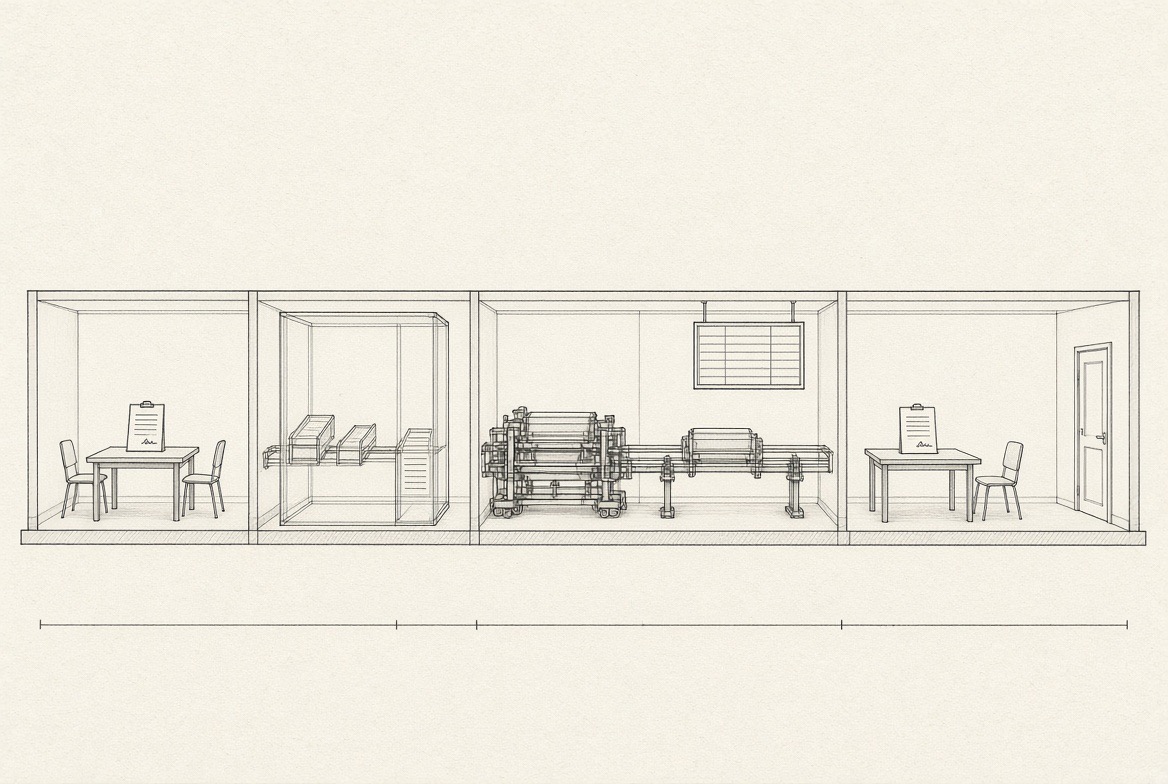
Ninety days is not a transformation. It is the shortest window in which a twin can see live files, produce a comparison, and force a decision.
If that is not the brief, do not start.
The engagement is a CEO mandate plus twin architecture plus delivery of the first two workflows. The system has to exist in production. A slide deck at day 90 is a failed engagement.
Who is in the room
Keep it small enough that a Tuesday decision still happens on Tuesday.
– CEO or one named deputy: Hiring and killing authority. Not a digital board.
– Two named gate owners: One per workflow. They can refuse a draft. They cannot refuse the twin’s existence.
– Finance: Instruments the parallel run: cycle time, quality, cost, risk. Same inputs, both paths.
– Legal and information security: Week one, not after the first incident. Guardrails are the product.
– A build cell: Few enough people to ship. Capability transfer is a deliverable, not a loan from the core.
If the first action is a partners’ meeting or a steering committee, you picked the identity, not the factory. Stop.
Artifacts that must exist on paper
If an artifact is missing, the calendar is fiction.
1. One-page mandate. Reporting line. Two chains. Right to the live file. Guardrails in the first build. Comparison rule. Who signs retirement. Budget past the next forecast.
2. 70% score for the line. Margin, coordination vs. judgment, owned data, regulatory surface, reconstructable trust. One line. Not twelve.
3. Two workflow cards. Input → output → gate → system of record → owner → baseline metrics. Adjacent chains.
4. Guardrail pack. Evaluation suite, log schema, rollback, human review queue. Agents as supervised juniors.
5. Parallel-run scoreboard. Live from the first comparable instance. Days, error rate, cost per file, incidents. Not hours “saved.”
6. Transfer note. Who in the firm owns the loop when the builder leaves. Names.
The clock
Days 0–10: Mandate or no start
Score the line. Name the two workflows. Sign the mandate. Put legal and security on the guardrail pack. If five of the six mandate tests fail, do not stand up agents.
Days 11–35: Twin on live files
Stand up the stack on the two chains: Sense, Interpret, Decide, Orchestrate, Learn. Humans on every material gate. Same inputs the core already receives. Drafts land in a review queue, not in last year’s sandbox.
Days 36–75: Parallel run
Old path and new path, same pack. Four weeks of instances is a serious first pass. Finance owns the board. Gate owners refuse or release. Learn compares the twin’s draft with what was signed.
Days 76–90: First verdict
Read the scoreboard. If the twin wins, the named signer retires the old path for the compressible share of those two workflows. If it does not win, say so. Then fix the chain or stop.
Day 90 is a decision. It is not “the company is AI-native.” Growing the edge into the core takes 9 to 20 months. That clock starts only if the first two workflows survive this one.
Not in scope
– A platform program as precondition
– Headcount design
– A firm-wide AI policy as the deliverable
– A model trained from scratch
– One workflow from each department to keep the peace
– The sacred cow and the science project
– A lighthouse chatbot
– Change-management roadshows
– Opinion work, one-off turnkeys, courtroom craft
A test at the door
Can you name the two chains, the single executive, the live-file date, the guardrails in the first build, the retirement signer, and the budget past the next forecast?
Five yeses is enough. Ninety days later, you should have a twin that ran, a board of numbers, and a person who can retire the loser. Everything else is the next workflow — or an honest stop.