
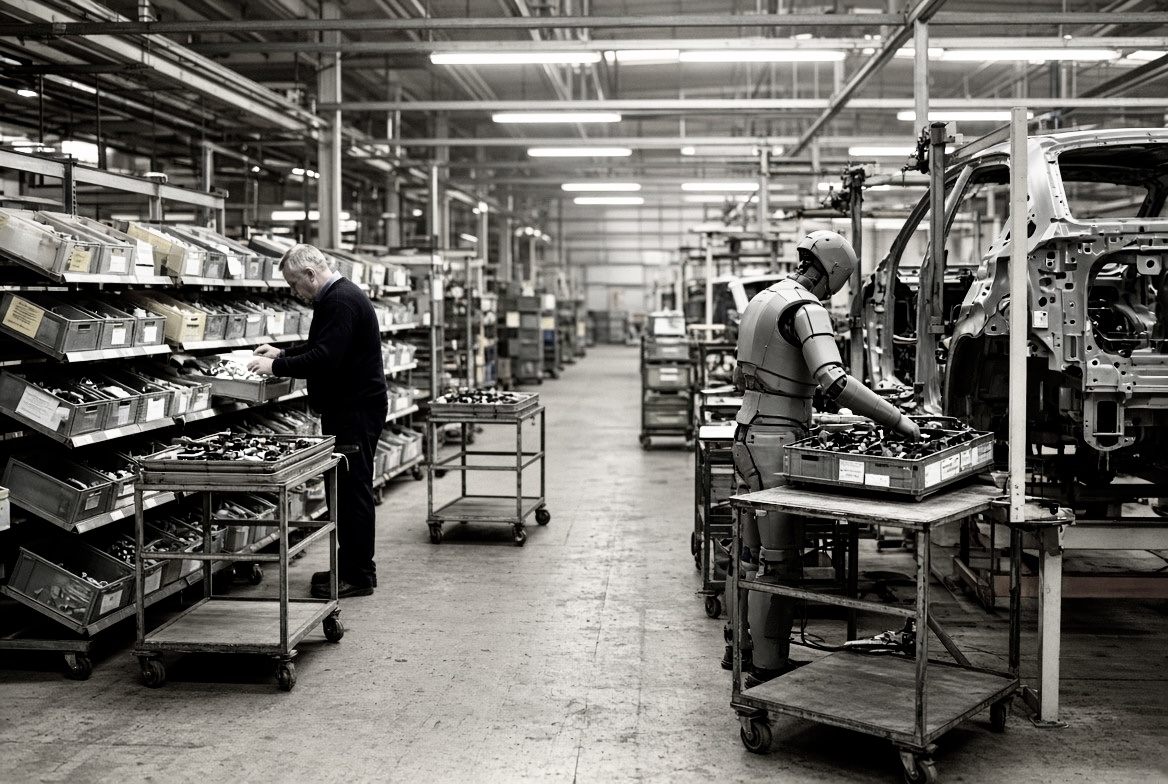
A weld, a pick, and a shipment are still a chain. Name what goes in and what must come out. Then pick two chains that share a part number — not two cells that share a slide.
A plant does not start with a robot. It starts with a job that already has a beat, a part, and a place for that part.
Same rule as on paper. A workflow is a repeatable sequence: something arrives, someone decides, something is done, a record is left. If you cannot write those four on one line, you do not have a workflow. You have a department. Or a cell. Or a tour.
Physical work is only different at the end. The last act is a hand, a gripper, a cart. The temptation is to talk about the machine — humanoid, AMR (Autonomous Mobile Robots), six-axis, whatever name is circulating this month. That is the wrong first sentence. The first sentence is still: from this input to that committed output.
Work already written as a chain
Spear and Bowen put Toyota’s first rule in plain language: say exactly what is done, in what order, in how long, and what “done” looks like. At Georgetown, fitting the right-front seat of a Camry was seven tasks. Fifty-five seconds. Bolts in a fixed order. Torque named. That is not “trim.” That is: body in the zone, seat in sequence, seat on the car to spec.
Set Parts Supply cuts the same work one step earlier. Picking and fitting are no longer the same person’s problem. A signal names the car. Someone builds a set. The set rides to the station. The fitter does not hunt the rack. The empty goes back.
Two jobs, next to each other, sharing the car’s number:
1. The sequence call → a checked kit at the station
2. That kit, plus the body in the zone → the part used, the empty returned
Toyota ran that pair long before anyone said “agent.” It is still the map. If the two jobs don’t share the unit’s identity, the new path learns the aisle and forgets the car.
The five tests do not get a holiday because something moves
Score the candidate. Two yeses on the first three tests, and a pass on four and five, is enough. Waiting for a perfect chain is how a steering group gets born.
1. Volume, not prestige.
Four weeks on the live line has to produce a pile of cases, not a film crew. Kits, supermarket picks, milk-run drops, dock-to-slot putaways — those happen with the beat of the line. A humanoid folding a shirt for visitors does not. Toyota’s own demo took two weeks and about 1,500 tries to get a fabric fold almost clean. That is practice. It is not the first comparison. If you cannot picture fifty like-for-like cases in a quarter, pick another chain.
2. Heavy on fetching and checking, light on judgment in the middle.
The work you can rebuild is still the hunting, assembling a set, routing, the tick, the tap on the shoulder. Walking to the rack is waste. So is a system that re-decides the bin when the light already said. A person still owns the stop, the off-sequence kit, the deviation that will travel with the body. If most cases cannot run as a chain, you picked a craft. Inventing a weld path for every panel is a craft. Building the same class of kit two hundred times a shift is a workflow.
3. The same diet the old path already eats.
Use the sequence file the line already broadcasts. The cord the team already pulls. The card the supermarket already honors. The output is a physical fact in a record: kit good, part used, unit in the next bank, empty back in play. Four numbers, already in the plant or standable in days: time against takt, wrong-part rate, cost per kit or drop, incidents you can weigh. Learning from a pretty model of the aisle is a hall of mirrors. Learning from the tag the seat already wears is a fair fight.
4. If it goes wrong for two weeks, the franchise still stands.
This is where plants get excited and pick the wrong first object. A late kit you can recover. A wrong torque on a safety joint, a weld on the wrong panel, a body released into paint — those are not first objects. You cannot un-weld. You can refuse the next place, hold the unit, hold the batch, and say who allowed the move. Start where you can still put the piece back: putaway, kitting, presenting the set, sending the empty home, diverting before the join that sticks. The line may already stop. The new path does not get to learn by driving through a missing stop.
5. One name who can change the path.
A team leader who owns the zone. A logistics engineer who owns the run. A dock supervisor who owns slotting. If the owner is “the digital factory program,” you will get a pilot and a fence. Takaoka’s parts robots — on the order of 160 movers, so people are not walking the length of the plant — have an owner. That is the shape. The comparison still goes to the chief executive. The first two jobs have to be close enough to that desk that a weekly scoreboard does not need six signatures.
What the plant will try to pick instead
People do not pick workflows. They pick what will not start a fight.
The body that photographs.
A humanoid at the bench for the visit. Toyota’s ELEY is a real machine—wheeled, about fifty kilos, taught to pick and fold. The 400,000-robot number that traveled with it in September 2026 is a fleet plan. A body is reached. It is not the first chain.
The cell the plant already loves.
“We have robots in body weld.” Yes. Georgetown’s body shop has been automated for a generation. Starting there is asking the building for permission to exist. Start on the walking and the searching — the kit aisle, the supermarket, the dock — not inside the booth that already has a nameplate.
The aisle nobody important owns.
Easy yes. No one will retire the real milk run when you win. You will be congratulated and left at the edge of the car park.
The program that must invent the factory first.
A general-purpose robot, a model of every bay, a legal opinion on machines that change their own behavior. That is research. It is not ninety days.
If the proposed work sits in any of those four, it is the wrong first object, even if the poster says physical AI.
The pair we would rebuild first
Which pair you pick depends on which line is actually exposed. In most discrete plants it is not “the robot.” It is the flow that a small team could copy: the commitment you sell, the spare that pays you — and on the floor, the material factory that feeds the beat.
Two pairs get through the tests. They share the unit’s name. That is why you pick two.
Pair A — the mix already running
Workflow 1. Sequence call → checked kit at the station.
- What comes in: the live sequence the line already sends — the same scan that prints the sheet and warns the sequenced-parts supplier.
- What goes out: a set on a tray at the station, contents against the car, every swap written down.
- Who says no: a person, if the set is short or belongs to the wrong body.
- What is kept: the kit tied to the car.
Workflow 2. That kit + the body in the zone → part used, empty home.
- What comes in: the kit from the first job, and the body that just entered.
- What goes out: use posted, empty on the way back, line stopped if part and body disagree.
- Who says no: stop on mismatch. Not a score. A stop.
- What is kept: the same car file, now with a physical event on it.
That is Set Parts Supply written as two neighboring jobs. Look at the thing, not only the row. Do not move on a status from this morning. Do not treat a clean pick of the wrong serial as a win.
Pair B — the dock and the supermarket
Workflow 1. Arrival + a look at the thing → a slot, or a hold.
- What comes in: the advance notice and the unit on the dock.
- What goes out: put away in a named slot, or held.
- Who says no: no slot until someone has seen this object, not a code that never touched it.
Workflow 2. Pull from that slot → drop at the next supermarket or kit aisle.
- What comes in: the pull the next process already sends.
- What goes out: the drop, on the route’s clock, empty counted.
- Who says no: a missed window is an incident, not a story about hours saved.
Do not take one job from A and one from B to keep two directors happy. Two jobs show whether the same system can do the neighboring work. A compromise pair gives you two orphans and a machine that learned the wrong plant.
What has to happen on the live floor
These are jobs, not layers on a poster.
- See the object and the zone — the tag, the tray, the body in station — as it happens, not when someone remembers to scan.
- Say whether this is the unit in sequence, a stand-in, or noise.
- Present, hold, or stop. A person signs the unusual and the thing you cannot undo.
- Move only on a fresh look. The cart, the runner, the arm borrow the right to move. They do not keep it overnight.
- Learn from events that actually touched the part. The plant’s memory is the history of this sequence and this object. It is not a vendor’s idea of “factory.”
People stay off the treadmill. They say yes or no at the gate. They do not hunt the rack, copy the sheet, and chase the empty. That is the difference between a second path you can compare and a helper with a gripper.
Do not start with the join you cannot undo
Toyota already automated the body shop. It already wrote the seat down to the bolt. It already took picking away from fitting so the fitter would not hunt. The only new fact is speed: those two neighboring chains can now run beside the old ones, on the same cars and the same files, long enough that the numbers force a choice.
The company path becomes the company only if what it handles can survive a machine touching it. Tie the record to the part. Name the chain. Pick two that share a sequence number. Run them next to what you already do. Retire what loses.
A body is not a workflow. Motion is not a plan. The first two workflows are the stretch of floor you can actually walk.