
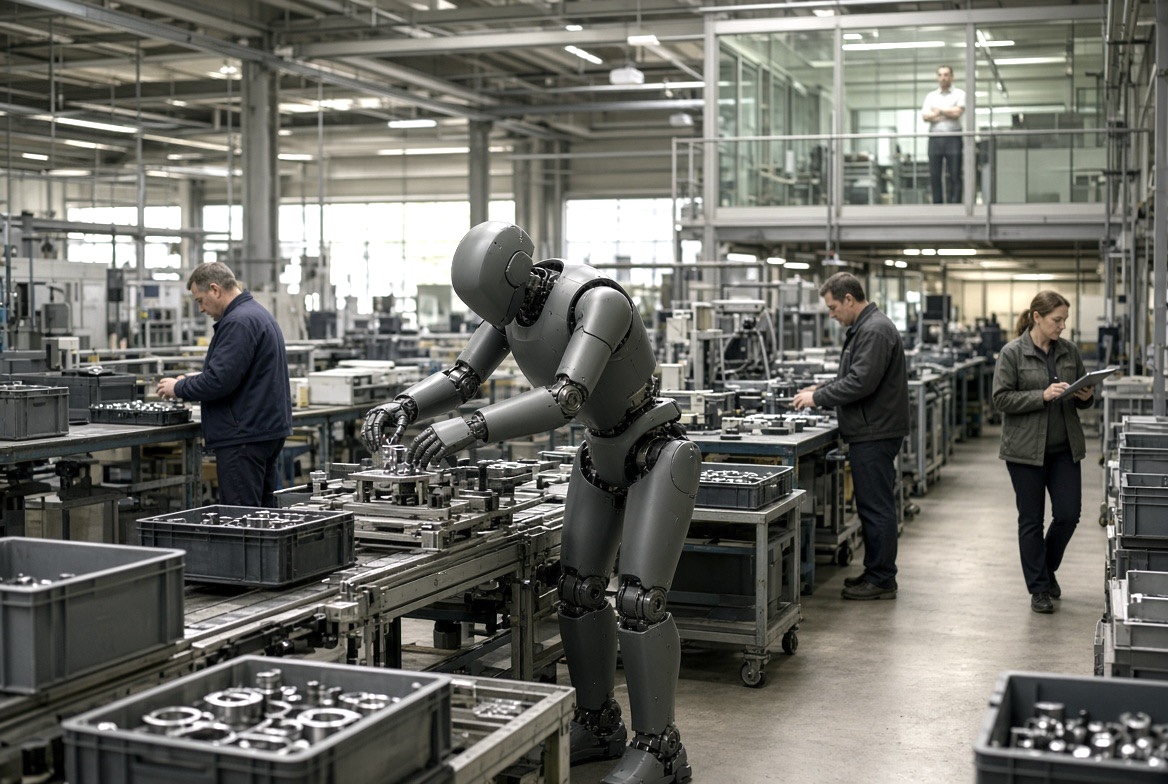
A robot that can move mass is still a junior. Tenure is not a kinematic degree of freedom.
About 4.7 million industrial robots were already in service in 2024. Density sat at 177 units per 10,000 manufacturing workers. Installations that year were 542,000. Humanoid sales in 2025, on the IFR’s first dedicated count, were about 7,000.
The factory already has bodies. What is being sold now is a promotion: the same sense–interpret–decide–orchestrate–learn loop, previously closed on files, tickets, and markets, closed on a fastener, a cell, a pack, a spare. The pitch treats embodiment as graduation. Fluency plus six axes becomes “autonomous colleague.”
That is a category error. A body is access. It is not evaluative agency. It is not a legal person. It is not a reason that survives a court, an underwriter, or a Tuesday morning incident review.
The promotion is happening in language first
Vendor decks collapse three different machines into one word.
A fixed industrial arm running a validated cycle is machinery. ISO 10218 and the cell around it already know what that is. A mobile manipulator that accepts a new goal from an agent stack is still machinery — plus a planner that can leave the envelope the risk file assumed. A humanoid walking a warehouse designed for people is a research program wearing a production badge.
Only the second and third change the Evolut stack. The first was already a control problem with a name, a CE mark, and a stop circuit. The second and third add a non-deterministic proposer to an actuator that can spend kilograms, amperes, and sterility.
The firm already learned, in software workflows, that today’s models surprise you and the firm cannot. Same inputs, different traces. Plans drift. A high score sits on an off-distribution case. That was tolerable when the output was a draft memo. It is not tolerable when the output is motion.
Europe will not wait for the humanoid
Regulation (EU) 2023/1230 — the Machinery Regulation — applies from 20 January 2027. It replaces the 2006 Directive. Software that performs a safety function is a safety component. Safety components with fully or partially self-evolving behavior using machine learning sit in Annex I. If behavior can change after deployment, the safety assessment has to cover that evolution, not only the state at delivery.
That sentence is the opposite of a promotion. It requires that the junior remain inspectable after it has learned. The AI Act’s high-risk rules for systems embedded in Annex I products arrive later, through a sector overlap rather than a second parallel assessment. None of that delays the machinery date. None of it confers personhood on the arm.
A safety committee that signs the cell in 2026 and never sees the policy update in 2027 is not above the loop. It is a photograph of control.
What “junior with a body” actually means
We do not treat software agents as colleagues who have already earned autonomy. We treat them as junior staff: evaluated, logged, reversible, queued for review. Embodiment does not retire that sentence. It makes five clauses load-bearing.
1. Leased authority, not a standing right to move
Purpose, scope, workspace, payload, and time. The agent may persist as an identity. Its right to act on matter should expire and be reissued after fresh verification of the object and the cell. Permanent motion credentials on a junior that never sleeps is how a pick becomes a career.
2. Sense is an observation of the object, not a row in ERP.
The stack may not orchestrate on a cached status bit. If the binding to matter has not been proven in this cycle, the workflow stops. Inference of authenticity from a complete passport is a story. Stories are how the wrong cell leaves the fixture.
3. Decide may not outrun the last fresh check.
A fluent, off-envelope plan is refused, queued, or rolled back—before torque. The admissible state set is finite. The model proposes. The shell accepts only what matches schema, policy, and the last observation.
4. Rollback is a physical design, not a git revert.
You cannot un-weld. You can refuse the next act, isolate the unit, hold the batch, and reconstruct who authorized, on whose behalf, with what minimum privilege, and what the object actually was. If the record cannot answer those four in an afternoon, the twin is uninsurable, and the cell is a rumor.
5. A name on the irreversible step
Tracking and tracing still require a human who can understand the system’s effects and who knows that others may hold them responsible. Causal power means halt, modify, override — not a comment in the MES. Epistemic access means the object and the rationale, not a confidence score. Fitting intention means they are there to refuse, not to clear a queue measured on cycle time.
Remove one, and you have a human in position and no control. The immune system will staff the gate with whoever is cheap to roster. That is how plants get signatures and still ship the wrong pack.
The stack does not change. The failure mode does.
Sense, interpret, decide, orchestrate, learn remains the loop. Humans stay above it. The C-suite is present at every layer only to approve or refuse.
What changes when the last step is motion:
- Learn may accept training data only from anchored events. A successful pick of a cloned serial is not a reward.
- Orchestrate may not move matter on a policy the risk file has not seen.
- The parallel-run scoreboard is still cycle time, quality, cost, and risk—plus incidents that have mass. Hours “saved” remain a vanity metric.
- The transfer note names who owns the loop when the integrator leaves. A robot cell without that name is a vendor demo that grew a fence.
The first twin should still be two high-throughput workflows at the edge, inside the firewall, reporting to the chief executive. Embodiment is not a reason to start in the core. The plant immune system is older than the office one. It will give you a steering committee and call it functional safety.
Do not wait for the general-purpose body
The 7,000 humanoids are a visibility event. The 4.7 million industrial robots are the installed base. Physical AI arrives through the door software already opened: an agent stack that can retask a cell, close a planning exception, and release a unit without a human walking the aisle.
That is the on-ramp. The work is not to anthropomorphize the junior. The work is to keep the junior a junior while its reach becomes physical: inventory and a named owner, a short lease, classed controls, a breaker that fails closed, a record a director and a court can read from the same file.
A body is not a promotion. It is a larger blast radius for the same non-determinism.
Build the mandate. Bind the object. Staff the gate as a production function. Then let the stack touch the world.