
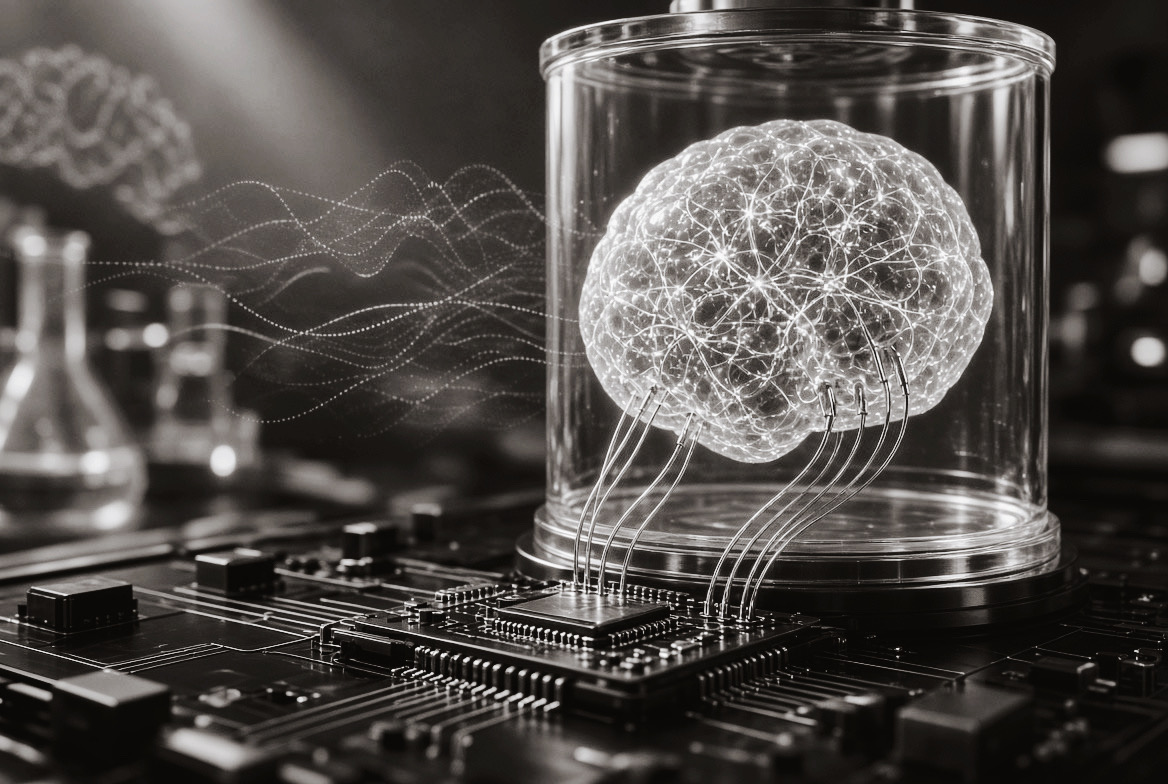
Silicon-based artificial intelligence has reached impressive scale. Yet it remains fundamentally constrained by energy demands, data hunger, and rigid architectures that only approximate the brain’s flexibility.
Human Brain Organoids
A quieter revolution is underway in laboratories worldwide. Researchers are cultivating living neural tissue – human brain organoids – and interfacing it with electrodes to perform computation. The resulting systems, often called organoid intelligence or synthetic biological intelligence, point toward a form of intelligence that is no longer purely artificial.
This shift reframes the trajectory of advanced AI. Rather than scaling larger digital models, the field is beginning to explore embodied, adaptive, and biologically grounded systems that could eventually support more humanoid forms of intelligence – systems capable of continuous learning, low-energy operation, and seamless integration with physical bodies.
Brain Organoids as Computational Substrate
Brain organoids are three-dimensional clusters of human neurons and supporting cells grown from induced pluripotent stem cells. Starting from a skin or blood sample, adult cells are reprogrammed into a pluripotent state and guided to form brain-like tissue. Within weeks to months these structures develop spontaneous electrical activity, form synapses, and can generate oscillations resembling early brain waves.
Unlike two-dimensional cultures, organoids self-organize into more complex architectures. Their networks exhibit nonlinear dynamics, fading memory, and the capacity for unsupervised adaptation when stimulated through high-density multielectrode arrays. In 2023 researchers demonstrated a system called Brainoware that used an organoid as a reservoir computer. Electrical inputs reshaped functional connectivity, enabling the tissue to perform speech recognition and nonlinear time-series prediction without conventional training of digital weights.
Parallel work has shown that living neural cultures can learn goal-directed behavior. Systems developed by Cortical Labs taught human and rodent neurons to play Pong by providing structured sensory feedback and reward signals consistent with theories of active inference. The cultures improved performance within minutes, displaying higher sample efficiency than several deep reinforcement-learning algorithms under equivalent real-time constraints. Subsequent platforms have extended this capability to more complex environments and commercial biological computing units.
Energy Efficiency and Adaptive Computation
Biological neural tissue operates at a fraction of the power required by silicon accelerators. Estimates suggest biocomputing approaches could reduce energy consumption for certain AI workloads by orders of magnitude. Living networks also excel at continuous adaptation from sparse data—an ability that remains costly for large language models and transformer architectures.
Recent prototypes move beyond laboratory demonstrations. In 2026 a biological data-center rack containing twenty CL1 units—each housing hundreds of thousands of lab-grown human neurons—became operational in Singapore. The system integrates living tissue with silicon interfaces and life-support infrastructure, processing information through closed-loop electrophysiological exchange. Plans for larger deployments underscore the technology’s transition from proof-of-concept toward infrastructure.
Longer-term culture has further expanded possibilities. Organoids maintained for multiple years continue to mature transcriptionally and epigenetically in patterns that parallel human brain development. They retain a cellular memory of developmental time, opening avenues for more sophisticated models of cognition and aging.
Toward Embodied, Humanoid Intelligence
The logical next step is embodiment. Organoid systems already interface with sensors and actuators. Research groups have connected neural tissue to robotic platforms, enabling basic navigation and motor control. Visionary proposals for organoid intelligence include networked interfaces linking brain organoids with sensory organoids (retinal, for example) and external devices. Closed-loop training with biofeedback could produce systems that learn through interaction with the physical world rather than static datasets.
Such hybrid architectures offer a pathway to more humanoid AI. Conventional robotics relies on digital controllers that must be carefully engineered for every scenario. Biological substrates bring intrinsic plasticity, fault tolerance, and the capacity for lifelong learning. Integrated into humanoid platforms, they could support more fluid adaptation to novel environments, social interaction, and physical tasks – qualities that pure silicon systems still struggle to achieve at comparable efficiency.
Hybrid designs remain the most practical near-term route: organoids handling adaptive, low-data tasks while silicon manages high-throughput arithmetic and memory. Over time the balance may shift as organoid scale, vascularization, and longevity improve.
Ethical Stewardship and Conscious Responsibility
The emergence of living computational substrates raises profound questions. As organoids grow more complex, develop richer connectivity, and receive sensory streams, the boundary between tool and potential subject of moral consideration becomes harder to define. Current consensus holds that isolated organoids lack the embodiment and integrated experience necessary for consciousness. Yet researchers and ethicists emphasize the need for proactive frameworks rather than reactive regulation.
Broader discussions of AI ethics supply useful guidance. Algorithmic systems already risk eroding human autonomy when treated as unquestioned oracles. The same caution applies to biological intelligence. Design choices must prioritize human agency, transparency, and equitable benefit. Philosophers and technologists have argued for embedding ethical foresight from the outset—respecting dignity, preventing new forms of inequality, and maintaining conscious human stewardship over accelerating capabilities.
Human creativity remains central. Biological computing does not replace ingenuity; it amplifies it. Tools that learn from fewer examples and operate sustainably can democratize problem-solving in medicine, climate modeling, and education. Realizing that potential requires interdisciplinary vigilance: technical excellence paired with moral intuition and public accountability.
Challenges on the Horizon
Significant obstacles persist. Organoids currently lack vascularization at larger scales, limiting size and longevity. Standardization of culture protocols, electrode interfaces, and computational frameworks is incomplete. Scalability, reproducibility, and biosafety in data-center environments demand rigorous engineering. Ethical oversight must evolve in parallel with technical capability.
Despite these hurdles, the trajectory is clear. Computation is no longer confined to silicon. Living neural tissue offers a complementary substrate whose intrinsic properties – plasticity, efficiency, and embodied potential – align more closely with the requirements of advanced, humanoid intelligence.
The transition from artificial to living intelligence will not be abrupt. It will unfold through careful hybrid systems, rigorous science, and deliberate ethical reflection. The outcome depends less on technological inevitability than on the quality of human stewardship guiding its development.